
Printing Paper Weight, Grades & Finishing Explained
US Paper Naming: lb, pt, and GSM Explained
Paper in the US has two naming systems — pounds (lb #) and points (pt). Other countries use weight (GSM). This confuses almost everyone. Use the tools below to identify paper across systems and find the right paper for your project in seconds.
Page Summary — This page explains how U.S. printing paper is measured and compared, including lb, pt, GSM, common equivalencies, synthetic stocks, and paper size standards, with tools and charts to help non-experts choose the right paper; quick answers include standard copy paper = 20lb bond, business cards = 14pt or 100lb cover, flyers = 60–80lb text, brochures = 100lb gloss text, and menus = 80lb cover or synthetic waterproof.
Find What Paper Is Available — Text, Cover & Cardstock
Choose a paper category to see all available options — names, finishes, GSM, and what each one is used for.
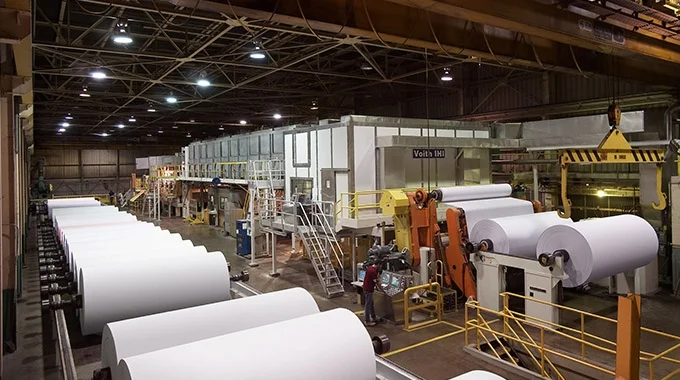
The roll width determines the paper family.
What Paper Do I Need for My Project?
Answer 2–3 quick questions and get a paper recommendation with a direct product link.
Paper Sizes Chart — US Standard & ISO
| Size Name | Inches | mm | Common Use |
|---|---|---|---|
| Letter | 8.5 × 11 | 216 × 279 | Copies, flyers, forms |
| Legal | 8.5 × 14 | 216 × 356 | Legal docs, menus |
| Ledger / Tabloid | 11 × 17 | 279 × 432 | Newsletters, programs, menus |
| Executive / Half-Letter | 5.5 × 8.5 | 140 × 216 | Half-fold brochures, notepads |
| Business Card | 2 × 3.5 | 51 × 89 | Business cards |
How US Paper Weight Works (Basis Weight)
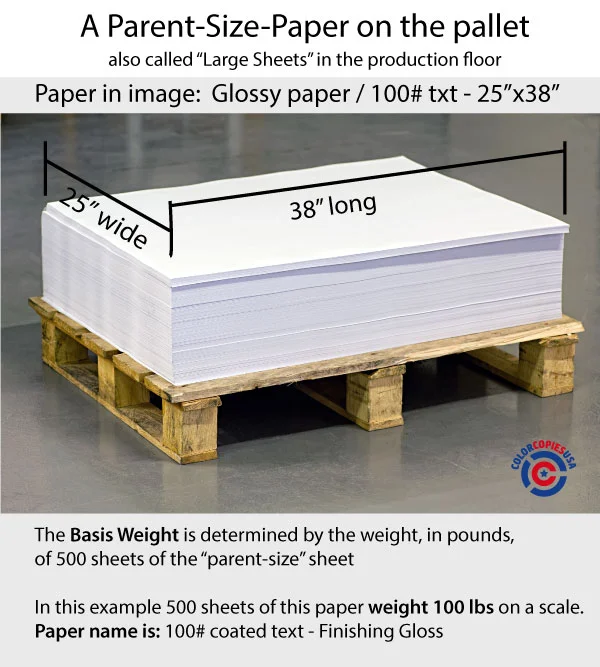
The short version: Paper is weighed in batches of 500 sheets at the factory, before cutting. That batch weight becomes the paper's name. Because different paper types are cut from different factory-size sheets, the same physical paper can carry two different pound numbers depending on where it was made.
Why 20lb bond and 50lb text are the same paper
Bond paper is factory-cut from 17"×22" sheets. Text paper from 25"×38" sheets. The same physical paper run through both lines: bond version = 20lb, text version = 50lb. Same paper, two names. The converter above handles this automatically.
| Paper Family | Factory Sheet | Typical Use | Common Weights |
|---|---|---|---|
| Bond | 17" × 22" | Copies, letterhead, forms | 20lb, 24lb, 28lb, 32lb |
| Text / Book | 25" × 38" | Flyers, brochures, magazines | 60lb, 70lb, 80lb, 100lb |
| Cover | 20" × 26" | Business cards, covers, postcards | 65lb, 80lb, 100lb |
| Index | 25½" × 30½" | Postcards, index cards, dividers | 90lb, 110lb, 140lb |
What Does "pt" (Point) Mean?
Cardstock is often measured in points (pt). One point = 0.001 inch. So 14pt cardstock = 0.014" thick. This system is common for business cards, menus, postcards, and book covers — and it's entirely separate from the lb system.
| pt | Thickness | ≈ Cover lb | GSM | Typical Use |
|---|---|---|---|---|
| 8pt | 0.008" | ~65lb | ~177 | Light postcards, rack cards |
| 10pt | 0.010" | ~80lb | ~218 | Postcards, greeting cards |
| 12pt | 0.012" | ~90lb | ~253 | Book covers, premium folders |
| 14pt | 0.014" | ~100lb | ~306 | Standard business card stock ✓ |
| 16pt | 0.016" | ~130lb | ~330 | Ultra-thick cards, heavy covers |
| 18pt | 0.018" | ~160lb | ~358 | Premium thick cards, luxury covers |
80lb vs 100lb Paper — What's the Difference?
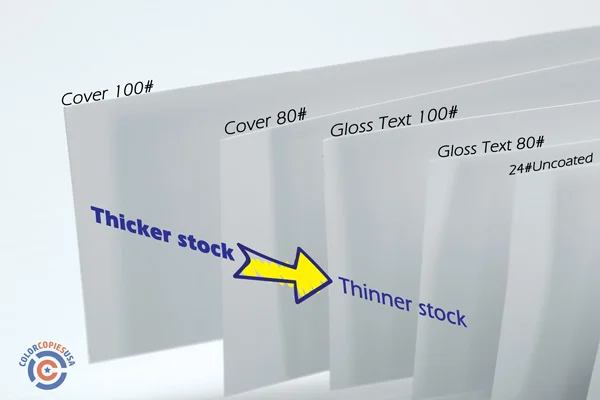
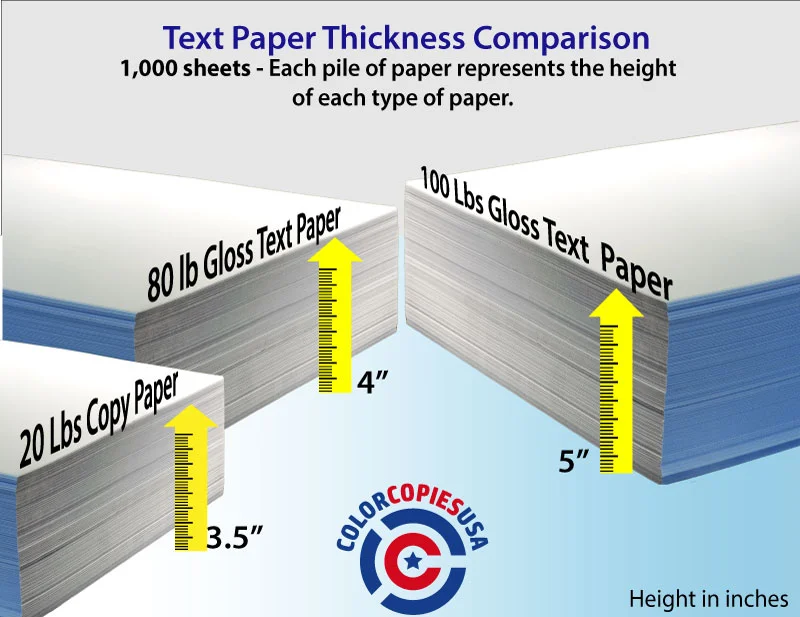
The answer depends on which family you're comparing. Text and Cover paper share pound numbers but are very different sheets.
| Paper | GSM | Feel | Best For |
|---|---|---|---|
| 80lb Gloss Text | 118 | Light, flexible | Single-sheet flyers, inserts |
| 100lb Gloss Text ✓ | 148 | Solid, premium | Brochures, booklet pages, menus |
| 80lb Cover | 216 | Stiff card | Postcards, rack cards, light covers |
| 100lb Cover ✓ | 234 | Very stiff cardstock | Business cards, premium covers |
Key distinction: Text vs. Cover
80lb cover is nearly twice as thick as 80lb text — even though they share the same number. For brochures, choose text. For business cards and postcards, choose cover. When in doubt, use the Paper Chooser above.
→ Read our full guide: What is the difference between 80lb and 100lb paper?
Paper Grades & Finishes
Paper "grade" describes what it's designed to do. Click any grade to expand.
A clay layer on the paper surface holds ink in a finer dot — producing sharper images and more vibrant color. Use coated paper whenever color quality matters.
- Gloss — High shine. Colors pop. Best for photos and marketing materials.
- Satin / Silk — Slight sheen, less glare. Popular all-around brochure choice.
- Dull / Matte — No shine, easy to read. Great for menus and text-heavy pieces.
- Cast Coated — Mirror-like finish. Luxury packaging and premium business cards.
No clay layer — ink absorbs into the fibers for a natural feel. Great for text-heavy documents, forms, and anything that will be written on. Available in smooth, vellum, laid, and linen textures. Common weights: 50–80lb text (same as 20–32lb bond).
Bond paper stays flat, takes pen and pencil well, and feeds reliably through office laser printers. Standard copy paper is 20lb bond. Premium letterhead is 24–32lb bond. Cotton-content bond (25% or 100%) is used for legal documents and diplomas — tear-resistant and ages better.
Thick, stiff paper where rigidity matters. Can be coated (gloss/matte) or uncoated. Measured in both lb cover and pt (points).
- 65lb cover / 8pt — Light cardstock, greeting cards
- 80lb cover / 10pt — Postcards, rack cards
- 100lb cover / 14pt — Standard business card, brochure covers
- 130lb cover / 16pt — Ultra-thick business cards, heavy-duty covers
Brightness (0–100 scale) measures how much blue-spectrum light the paper reflects. Higher = whiter and more vivid-looking color.
- 90–100 — Bright white with blue-white tone. Best for photos and marketing. Premium coated papers.
- 84–89 — Standard office range. Most 20lb bond copy paper. Good for most documents.
- Below 84 — Cream or off-white tone. Typical for recycled/unbleached papers. Great for natural aesthetics, not for photo printing.
Full Paper Weight Equivalency Chart
Find any value in any column and read across the row for all equivalents.
| US Basis Weights by Family | Point | Metric | Real-World Use | |||
|---|---|---|---|---|---|---|
| Bond lb | Text lb | Cover lb | Index lb | pt | GSM | Use it for… |
| 20 | 50 | — | — | — | 75 | Standard copy paper. Color copies. |
| 24 | 60 | — | — | — | 90 | Premium letterhead. |
| 28 | 70 | — | — | — | 105 | Executive letterhead. |
| 32 | 80 | — | — | — | 120 | Resume paper, stationery. |
| 36 | 90 | 50 | — | — | 136 | Light brochure, inside pages. |
| 38 | 100 | 55 | — | 6pt | 140 | Flyers, church programs. |
| 43 | 110 | 60 | 90 | — | 162 | Heavier flyers, folded brochures. |
| 47 | 120 | 65 | 97 | 8pt | 177 | Rack cards, door hangers. |
| 54 | — | 74 | 110 | — | 199 | Postcards, folder covers. |
| 58 | — | 80 | 120 | 10pt | 218 | Postcards, greeting cards. |
| — | — | 90 | 135 | — | 245 | Heavy covers, presentation folders. |
| — | — | 93 | 140 | 12pt | 253 | Business cards, book covers. |
| — | — | 100 | 150 | — | 234 | Standard business card weight. Premium covers. |
| — | — | — | — | 14pt | 306 | Standard business card caliper. Solid, professional feel. |
| — | — | 130 | 200 | 16pt | 330 | Ultra-thick cards, heavy covers. |
| — | — | — | — | 18pt | 358 | Premium luxury cards, extra-heavy covers. |
Synthetic (Waterproof) Paper — a Different Category Entirely
Synthetic paper is not paper at all — it's an extruded polypropylene film manufactured to look and print like paper. It is completely waterproof, tear-resistant, and wipe-clean, which makes it the preferred material for restaurant menus, outdoor signage, field-use documents, and any printed piece that will be handled repeatedly or exposed to moisture.
Key properties of synthetic paper
- Waterproof: Does not absorb water, grease, or liquids. Wipes clean with a damp cloth.
- Tear-resistant: Will not rip or fray at the edges under normal handling.
- Maximum print size: Because it is an extruded film, the maximum sheet size is 13"×19". It can be trimmed to any smaller custom size.
- Available thicknesses: Multiple caliper options are available — thicker for covers and menus, thinner for inserts and overlays. See the product page for current thickness options.
- Printing: Prints with high color fidelity on laser digital presses. Color accuracy and vibrancy are similar to coated paper.
- Not weight-rated: Synthetic paper is specified by caliper (mil or pt), not by lb or GSM. The lb/pt converter above does not apply to synthetic substrates.
Frequently Asked Questions
- What is 20lb bond paper?
- Standard copy paper — the paper in your office printer. Equivalent to 50lb text (75 GSM). Light and flexible. The most common paper for color copies at ColorCopiesUSA.
- What is 14pt cardstock in pounds?
- 14pt is sold as approximately 100lb cover stock, though they measure different properties: lb measures weight, pt measures caliper (thickness). 14pt cardstock has a caliper of 0.014" and a GSM of approximately 306. It's the standard business card weight — solid professional feel, fits in a wallet.
- What is the difference between 80lb text and 80lb cover?
- 80lb text (118 GSM) is thin and flexible — good for flyers and brochure pages. 80lb cover (216 GSM) is thick stiff cardstock, nearly twice as thick. Always specify text or cover when ordering.
- What paper should I use for a restaurant menu?
- For frequently handled menus: synthetic waterproof paper — wipes clean, will not tear or absorb grease. For laminated menus: 100lb gloss text or 80lb cover. For a spiral-bound menu booklet: 80lb gloss text inside, 100lb cover front and back.
- What does GSM mean?
- Grams per Square Meter — the international way to measure paper weight. Unlike US lb weights, GSM always measures the same area regardless of manufacturing origin, making it universally comparable. Use the converter above.
- What paper does ColorCopiesUSA use for color copies?
- Our standard color copies are on 20lb bond (75 GSM). We also offer 60lb and 80lb uncoated text, 100lb gloss text, and 80lb and 100lb cover. Choose your paper when you order color copies.
Ready to order? Choose the right paper for your project.
All products ship nationwide from Oakland Park, FL. Bilingual support available — hablamos español.
Color CopiesBusiness CardsBrochuresWaterproof / Synthetic PaperMore from the Academy

Published: 2020-03-01 // Updated: 2026-03-27