
Printing Paper Weight, Grades & Finishing Explained
US Paper Naming: lb, pt, and GSM Explained
Paper in the US has two naming systems — pounds (lb #) and points (pt). Other countries use weight (GSM). This confuses almost everyone. This page explains how the systems compare, lists every paper stock we offer with its specifications, and recommends the right paper for each type of printed piece.
Page Summary — This page explains how U.S. printing paper is measured and compared, including lb, pt, GSM, common equivalencies, synthetic stocks, and paper size standards, with tools and charts to help non-experts choose the right paper; quick answers include standard copy paper = 20lb bond, business cards = 14pt or 100lb cover, flyers = 60–80lb text, brochures = 100lb gloss text, and menus = 80lb cover or synthetic waterproof.
Find What Paper Is Available — Text, Cover & Cardstock
Choose a paper category to see all available options — names, finishes, GSM, and what each one is used for.
📄 Text Papers — writing, uncoated & coated 10 options
- 20lb Bond / 50lb Uncoated Text (75 GSM)
- Finish: Uncoated — smooth or vellum.
Use Case: Standard copy paper. Cost-effective for color copies, handouts, and everyday office printing. - 24lb Bond / 60lb Uncoated Text (90 GSM)
- Finish: Uncoated.
Use Case: Premium letterhead and correspondence. Slightly heavier than copy paper with crisper edges. - 28lb Bond / 70lb Uncoated Text (105 GSM)
- Finish: Uncoated.
Use Case: Executive letterhead, premium forms. Folds crisply for mailing. - 32lb Bond / 80lb Uncoated Text (120 GSM)
- Finish: Uncoated — smooth, vellum, linen, or laid.
Use Case: Resumes, premium stationery, heavier office printing. - 80lb Coated Text (118 GSM)
- Finish: Gloss, Satin, Matte, or Silk.
Use Case: Flyers, programs, and single-sheet inserts where color vibrancy matters. - 90lb Uncoated Text / 36lb Bond (136 GSM)
- Finish: Uncoated.
Use Case: Light brochure pages, event programs, folded handouts. - 100lb Uncoated Text / 38lb Bond (140 GSM)
- Finish: Uncoated.
Use Case: Flyers, church programs, community handouts. - 100lb Coated Text (148 GSM)
- ⭐ Most popular brochure stock.
Finish: Gloss, Satin, Matte, or Silk.
Use Case: The industry standard for tri-fold brochures and booklet pages. Folds cleanly and colors look vibrant. - 110lb Uncoated Text / 43lb Bond (162 GSM)
- Finish: Uncoated or light-coated.
Use Case: Heavier flyers and folded brochures. - 120lb Uncoated Text / 47lb Bond (177 GSM)
- Finish: Uncoated or Coated.
Use Case: Rack cards, door hangers, and lightweight postcards.
🗂️ Cover Papers — cardstock, coated gloss or silk, index 6 options
- 74lb Cover / 54lb Bond (199 GSM)
- Finish: Coated or Uncoated.
Use Case: Postcards and lightweight presentation folder covers. - 80lb Cover (216 GSM)— equivalent to 10pt caliper (218 GSM)
- Finish: Coated or Uncoated.
Use Case: Postcards, greeting cards, rack cards, and light booklet covers. - 90lb Cover (245 GSM)
- Finish: Coated or Uncoated.
Use Case: Heavy presentation covers, premium folders. - 93lb Cover (253 GSM)— equivalent to 12pt caliper
- Finish: Coated or Uncoated.
Use Case: Business cards, book covers, premium folders. - 100lb Cover (270 GSM)— equivalent to 14pt caliper (306 GSM)
- ⭐ Standard business card weight.
Finish: Coated or Uncoated.
Use Case: Business cards, premium brochure covers, postcards. Very stiff and holds its shape. - 130lb Cover (330 GSM)— equivalent to 16pt caliper
- Finish: Coated or Uncoated.
Use Case: Ultra-thick covers and heavy-duty business cards.
📦 Thick Cardstock by Caliper (pt) — measured in thousandths of an inch 6 options
- 8pt Cardstock (177 GSM)
- Thickness: 0.008 inches.
Finish: C2S (coated both sides) or C1S (coated one side).
Use Case: Light postcards, rack cards, lightweight mailers. - 10pt Cardstock (218 GSM)
- Thickness: 0.010 inches.
Finish: C2S or C1S.
Use Case: Postcards, mailers, sell sheets, rack cards, greeting cards. Meets minimum USPS postcard requirements. - 12pt Cardstock (253 GSM)
- Thickness: 0.012 inches.
Finish: C2S or C1S.
Use Case: Postcards, sell sheets, posters, heavier mailers, book covers. - 14pt Cardstock (306 GSM)
- ⭐ Most popular business card stock in the US.
Thickness: 0.014 inches.
Finish: C2S or C1S.
Use Case: Business cards, postcards, sell sheets, posters, mailers. Solid, professional feel that fits comfortably in a wallet. - 16pt Cardstock (330 GSM)
- Thickness: 0.016 inches.
Finish: C2S or C1S.
Use Case: Premium business cards, posters, sell sheets, heavy-duty mailers and covers. - 18pt Cardstock (358 GSM)
- Thickness: 0.018 inches.
Finish: C2S or C1S.
Use Case: Luxury business cards, high-end posters and sell sheets, extra-heavy covers.
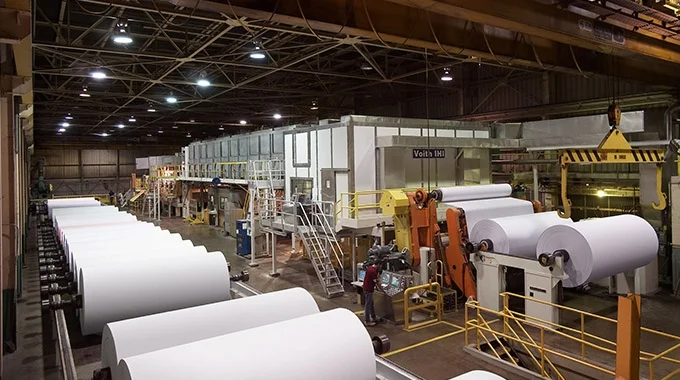
The roll width determines the paper family.
What Paper Do I Need for My Project?
Find your project below to see the recommended paper, why it works, and where to order. Each option includes the paper specs and a direct product link.
📋 Everyday copies / handouts — what paper should I use? 2 options
- Standard — 20lb Bond / 50lb Uncoated Text
- ⭐ Most popular for color copies.
Paper: 20lb Bond (75 GSM, equivalent to 50lb text).
Why: The standard paper for color copies and handouts. Cost-effective for large quantities.
Order:Order Color Copies → - Premium — 24lb Bond / 60lb Uncoated Text
- Paper: 24lb Bond (90 GSM, equivalent to 60lb text).
Why: Slightly heavier feel, crisper edges. Great for proposals and client-facing documents.
Order:Order Color Copies →
📣 Flyers — what paper should I use? 3 options
- Standard — 60lb Uncoated Text
- Paper: 60lb Uncoated Text (90 GSM).
Why: Budget-friendly and effective. Good for high-volume flyer runs for events, promotions, and community distribution.
Order:Order Flyers → - Premium gloss — 100lb Gloss Text
- ⭐ Most popular for marketing flyers.
Paper: 100lb Gloss Text (148 GSM) — magazine-quality stock.
Why: Colors pop on gloss text. A significant step up in perceived quality compared to standard uncoated.
Order:Order Flyers → - Uncoated / natural — 80lb Uncoated Text
- Paper: 80lb Uncoated Text (118 GSM) with a natural,
no-shine finish.
Why: Easy to write on. Great for mission-driven organizations and an eco-friendly aesthetic.
Order:Order Flyers →
📃 Brochures (folded) — what paper should I use? 3 options
- Standard gloss — 100lb Gloss Text
- ⭐ Industry standard for tri-fold brochures.
Paper: 100lb Gloss Text (148 GSM).
Why: Folds cleanly, colors look vibrant, feels substantial without being stiff.
Order:Order Brochures → - Premium satin / silk — 100lb Satin Text
- Paper: 100lb Satin or Silk Text (148 GSM).
Why: Less glare than gloss. Easier to read under bright light. Refined, high-end feel for premium brands.
Order:Order Brochures → - Uncoated / matte — 80lb Uncoated Text
- Paper: 80lb Uncoated Text (118 GSM) with a natural,
no-shine finish.
Why: Natural finish for organizations that want to convey an eco-friendly or artisan aesthetic.
Order:Order Brochures →
💼 Business cards — what paper should I use? 3 options
- Standard — 14pt Gloss Cardstock
- ⭐ Most popular business card stock.
Paper: 14pt Cardstock (306 GSM caliper) — sold as 100lb Cover (270 GSM basis weight). Available with gloss or matte coating.
Why: 14pt is the industry standard for business cards. Solid feel, fits comfortably in a wallet.
Order:Browse Business Cards → - Premium — 16pt Ultra-Thick Cardstock
- Paper: 16pt Cardstock (330 GSM) — sold as 130lb Cover.
Why: 16pt makes an immediate tactile impression. Noticeably thicker than standard — preferred by executives and luxury brands.
Order:Browse Business Cards → - Soft-touch — 14pt Matte with Soft-Touch Coating
- Paper: 14pt Matte Cardstock (306 GSM caliper, 100lb Cover
@ 270 GSM base) with soft-touch coating.
Why: Soft-touch coating gives cards a velvet-like feel that is distinctive and memorable. Best for premium brand cards where tactile experience matters.
Order:Order Soft-Touch Business Cards →
💧 Restaurant menus — frequently handled (waterproof) 1 option
- Synthetic Waterproof Paper
- ⭐ Best choice for frequently handled restaurant menus.
Paper: Synthetic waterproof paper — an extruded polypropylene film, specified by caliper (not by lb or GSM since it is not made of paper fibers).
Why: Does not absorb grease or water. Wipes clean with a damp cloth. Will not tear at the edges. Ideal for menus handled by many customers throughout the day.
Order:Order Waterproof Menus →
🍽️ Restaurant menus — single-use or lightweight (non-waterproof) 2 options
- Lightweight folded menus — 100lb Gloss Text
- ⭐ Most popular for daily-special or seasonal menus.
Paper: 100lb Gloss Text (148 GSM).
Why: Folds cleanly into bi-fold or tri-fold menus. Colors pop on gloss. Cost-effective for menus that get replaced regularly.
Order:Order Take-Out Menus → - Single-page menus in a holder — 80lb Cover
- Paper: 80lb Cover (216 GSM basis weight, 10pt caliper @
218 GSM). Available coated or uncoated.
Why: Stiff enough to stand up in a menu holder without curling. Good for cafés and counter-service spots.
Order:Order Take-Out Menus →
✉️ Postcards — what paper should I use? 2 options
- Standard — 14pt Cardstock
- ⭐ Industry-standard postcard weight.
Paper: 14pt Cardstock (306 GSM caliper) — equivalent to 100lb Cover (270 GSM basis weight).
Why: Meets USPS requirements for mailing. Stiff enough to send without an envelope. Insider tip: At ColorCopiesUSA we typically print 14pt postcard orders on 16pt stock at no extra charge — they look and feel more solid in the mail.
Order:Order Standard Postcards → - Heavy / Premium — 16pt Cardstock
- Paper: 16pt Cardstock (330 GSM) — equivalent to 130lb
Cover.
Why: Maximum stiffness and tactile impact. Less likely to bend in transit. Preferred for real estate mailers, hospitality promotions, and high-end direct mail where first impressions matter.
Order:Order Standard Postcards →
📚 Programs, booklets & multipage catalogs — what paper should I use? 3 options
- Standard programs, church bulletins & event catalogs
- ⭐ Most popular for community organizations, churches, schools, and
event programs.
Paper: 80lb or 100lb Gloss Text for inside pages; 80lb or 100lb Cover for the cover.
Why: The standard for short-run printed programs and bulletins. Available in saddle-stitch (most common — folded and stapled, up to ~64 pages), coil-bound, or wire-O bound. Coil and wire-O options can include clear plastic or black plastic protective covers for a more polished, durable presentation that stands up to repeated handling.
Order:Browse Booklet Options → - Training manuals & seminar workbooks
- Paper: 80lb Uncoated Text for inside pages (easy to write
on); 100lb or 130lb Cover for the cover.
Why: Spiral or coil binding lets the book lay flat for note-taking and pages turn easily. Ideal for instructor-led training, seminar workbooks, and reference manuals that need to be opened on a desk.
Order:Order Training Manuals → - Waterproof booklets — restaurants, marine, outdoor
- Paper: Synthetic waterproof paper (extruded polypropylene
film, specified by caliper).
Why: Withstands wet conditions, grease, and repeated handling. Wipes clean with a damp cloth. Ideal for restaurant menu booklets, field reference guides, and marine or outdoor use where standard paper would fail.
Order:Order Waterproof Booklets →
Paper Sizes Chart — US Standard & ISO
| Size Name | Inches | mm | Common Use |
|---|---|---|---|
| Letter | 8.5 × 11 | 216 × 279 | Copies, flyers, forms |
| Legal | 8.5 × 14 | 216 × 356 | Legal docs, menus |
| Ledger / Tabloid | 11 × 17 | 279 × 432 | Newsletters, programs, menus |
| Executive / Half-Letter | 5.5 × 8.5 | 140 × 216 | Half-fold brochures, notepads |
| Business Card | 2 × 3.5 | 51 × 89 | Business cards |
How US Paper Weight Works (Basis Weight)
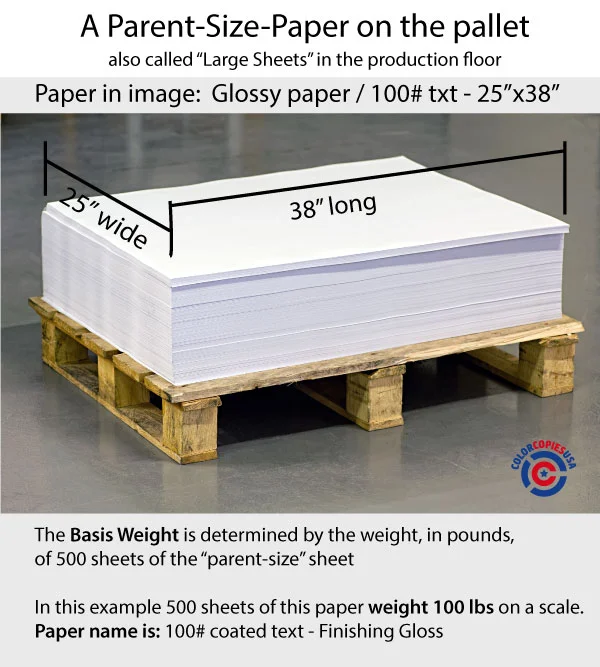
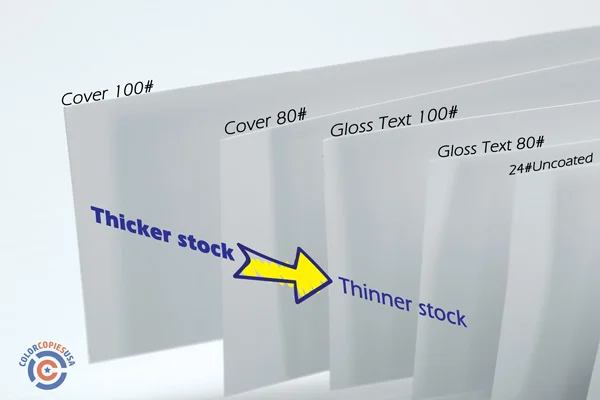
The short version: Paper is weighed in batches of 500 sheets at the factory, before cutting. That batch weight becomes the paper's name. Because different paper types are cut from different factory-size sheets, the same physical paper can carry two different pound numbers depending on where it was made.
Why 20lb bond and 50lb text are the same paper
Bond paper is factory-cut from 17"×22" sheets. Text paper from 25"×38" sheets. The same physical paper run through both lines: Bond version = 20lb, text version = 50lb. Same paper, two names. The Equivalency Chart later on this page shows every cross-family match.
| Paper Family | Factory Sheet | Typical Use | Common Weights |
|---|---|---|---|
| Bond | 17" × 22" | Copies, letterhead, forms | 20lb, 24lb, 28lb, 32lb |
| Text / Book | 25" × 38" | Flyers, brochures, magazines | 60lb, 70lb, 80lb, 100lb |
| Cover | 20" × 26" | Business cards, covers, postcards | 65lb, 80lb, 100lb |
| Index | 25½" × 30½" | Postcards, index cards, dividers | 90lb, 110lb, 140lb |
What Does "pt" (Point) Mean?
Cardstock is often measured in points (pt). One point = 0.001 inch. So 14pt cardstock = 0.014" thick. This system is common for business cards, menus, postcards, and book covers — and it's entirely separate from the lb system.
| pt | Thickness | ≈ Cover lb | GSM | Typical Use |
|---|---|---|---|---|
| 8pt | 0.008" | ~65lb | ~177 | Light postcards, rack cards |
| 10pt | 0.010" | ~80lb | ~218 | Postcards, greeting cards |
| 12pt | 0.012" | ~90lb | ~253 | Book covers, premium folders |
| 14pt | 0.014" | ~100lb | ~306 | Standard business card stock ✓ |
| 16pt | 0.016" | ~130lb | ~330 | Ultra-thick cards, heavy covers |
| 18pt | 0.018" | ~160lb | ~358 | Premium thick cards, luxury covers |
80lb vs 100lb Paper — What's the Difference?
The answer depends on which family you're comparing. Text and Cover paper share pound numbers but are very different sheets.
| Paper | GSM | Feel | Best For |
|---|---|---|---|
| 80lb Gloss Text | 118 | Light, flexible | Single-sheet flyers, inserts |
| 100lb Gloss Text ✓ | 148 | Solid, premium | Brochures, booklet pages, menus |
| 80lb Cover | 216 | Stiff card | Postcards, rack cards, light covers |
| 100lb Cover ✓ | 270 | Very stiff cardstock | Business cards, premium covers |
Key distinction: Text vs. Cover
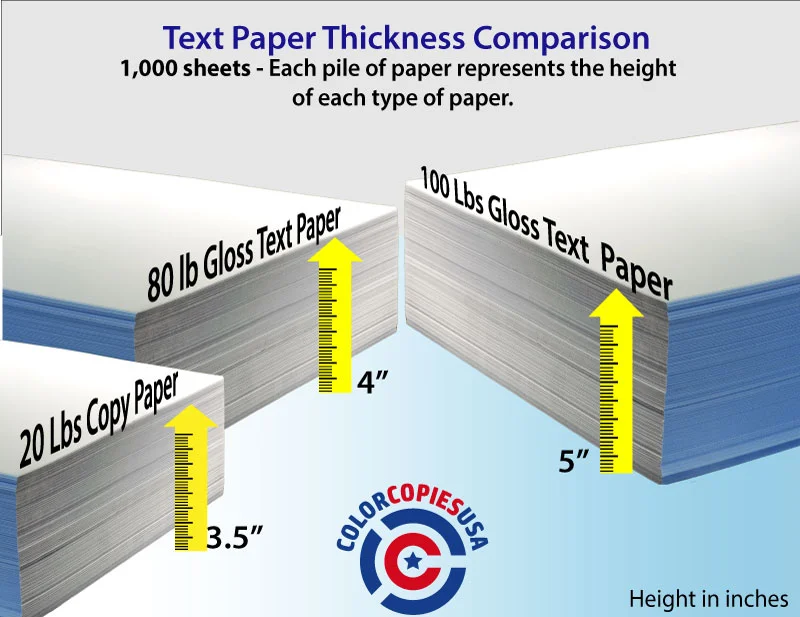
80lb cover is nearly twice as thick as 80lb text — even though they share the same number. For brochures, choose text. For brochures, choose text. For business cards and postcards, choose cover. The project-by-project paper guide earlier on this page recommends the right weight for each common use.
→ Read our full guide: What is the difference between 80lb and 100lb paper?
Paper Grades & Finishes
Paper "grade" describes what it's designed to do. Click any grade to expand.
A clay layer on the paper surface holds ink in a finer dot — producing sharper images and more vibrant color. Use coated paper whenever color quality matters.
- Gloss — High shine. Colors pop. Best for photos and marketing materials.
- Satin / Silk — Slight sheen, less glare. Popular all-around brochure choice.
- Dull / Matte — No shine, easy to read. Great for menus and text-heavy pieces.
- Cast Coated — Mirror-like finish. Luxury packaging and premium business cards.
No clay layer — ink absorbs into the fibers for a natural feel. Great for text-heavy documents, forms, and anything that will be written on. Available in smooth, vellum, laid, and linen textures. Common weights: 50–80lb text (same as 20–32lb bond).
Bond paper stays flat, takes pen and pencil well, and feeds reliably through office laser printers. Standard copy paper is 20lb bond. Premium letterhead is 24–32lb bond. Cotton-content bond (25% or 100%) is used for legal documents and diplomas — tear-resistant and ages better.
Thick, stiff paper where rigidity matters. Can be coated (gloss/matte) or uncoated. Measured in both lb cover and pt (points).
- 65lb cover / 8pt — Light cardstock, greeting cards
- 80lb cover / 10pt — Postcards, rack cards
- 100lb cover / 14pt — Standard business card, brochure covers
- 130lb cover / 16pt — Ultra-thick business cards, heavy-duty covers
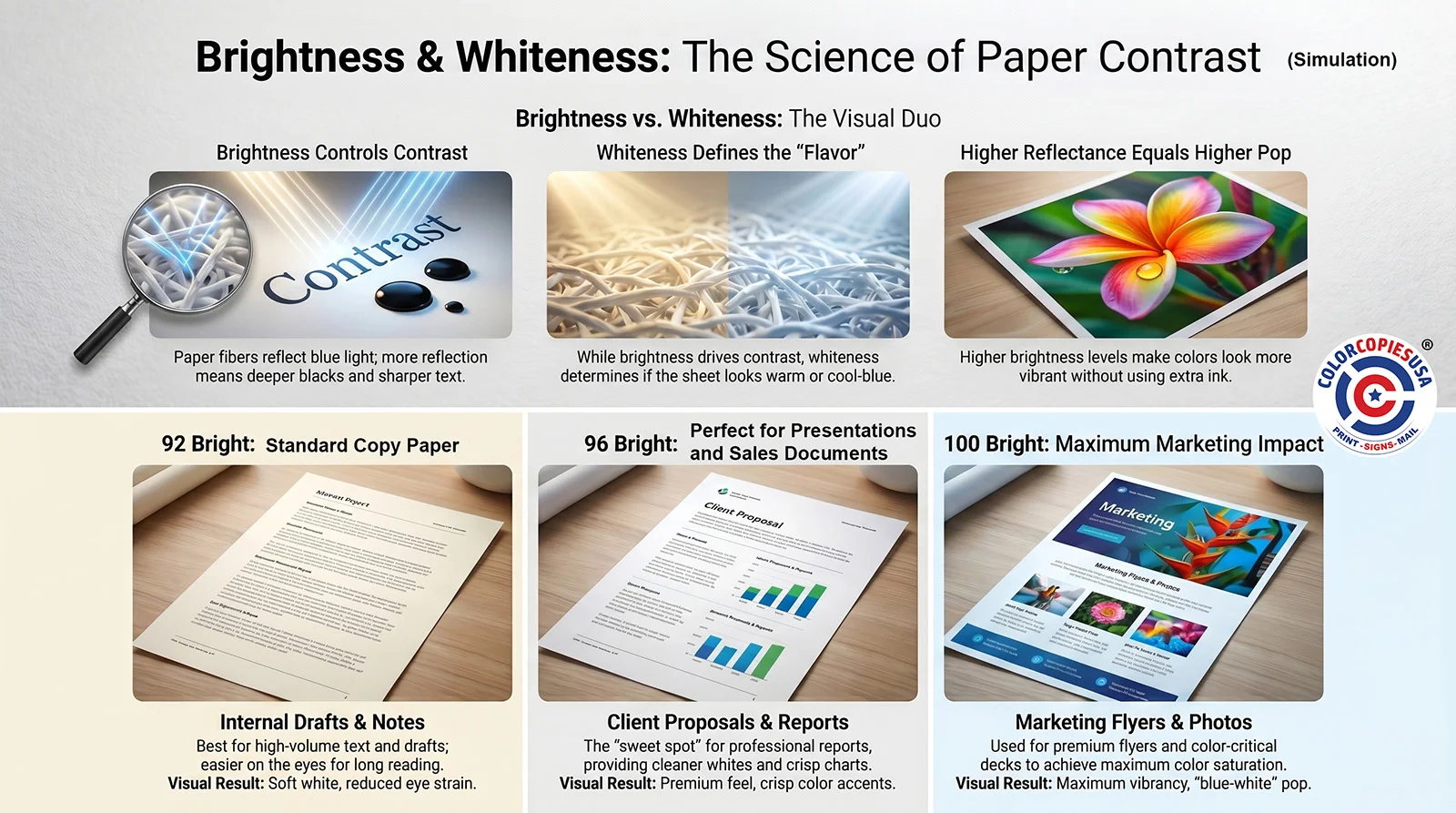
Brightness (0–100 scale) measures how much blue-spectrum light the paper reflects. Higher = whiter and more vivid-looking color.
- 92 - Standard Copy Print Paper — The most common 20lb and 24lb copy paper's brightness. Soft white tone, easy on the eyes for long reading. Best for drafts, internal notes, handouts where the message matters more than an upscale look.
- 96 - Client Preferred — Cleaner white with crisp color accents. The sweet spot for client proposals, reports, premium handouts. Better opacity.
- 100 - Marketing Impact — These specialty papers make colors pop. This brightness feel very upscale.
- Below 86 - Cream / off-white — Typical for recycled or unbleached papers. Great for natural aesthetics, not ideal for photo printing.
Full Paper Weight Equivalency Chart
Find any value in any column and read across the row for all equivalents.
| US Basis Weights by Family | Point | Metric | Real-World Use | |||
|---|---|---|---|---|---|---|
| Bond lb | Text lb | Cover lb | Index lb | pt | GSM | Use it for… |
| 20 | 50 | — | — | — | 75 | Standard copy paper. Color copies. |
| 24 | 60 | — | — | — | 90 | Premium letterhead. |
| 28 | 70 | — | — | — | 105 | Executive letterhead. |
| 32 | 80 | — | — | — | 120 | Resume paper, stationery. |
| 36 | 90 | 50 | — | — | 136 | Light brochure, inside pages. |
| 38 | 100 | 55 | — | 6pt | 140 | Flyers, church programs. |
| 43 | 110 | 60 | 90 | — | 162 | Heavier flyers, folded brochures. |
| 47 | 120 | 65 | 97 | 8pt | 177 | Rack cards, door hangers. |
| 54 | — | 74 | 110 | — | 199 | Postcards, folder covers. |
| 58 | — | 80 | 120 | 10pt | 218 | Postcards, greeting cards. |
| — | — | 90 | 135 | — | 245 | Heavy covers, presentation folders. |
| — | — | 93 | 140 | 12pt | 253 | Business cards, book covers. |
| — | — | 100 | 150 | — | 270 | Standard business card weight. Premium covers. |
| — | — | — | — | 14pt | 306 | Standard business card caliper. Solid, professional feel. |
| — | — | 130 | 200 | 16pt | 330 | Ultra-thick cards, heavy covers. |
| — | — | — | — | 18pt | 358 | Premium luxury cards, extra-heavy covers. |
Synthetic (Waterproof) Paper — a Different Category Entirely
Synthetic paper is not paper at all — it's an extruded polypropylene film manufactured to look and print like paper. It is completely waterproof, tear-resistant, and wipe-clean, which makes it the preferred material for restaurant menus, outdoor signage, field-use documents, and any printed piece that will be handled repeatedly or exposed to moisture.
Key properties of synthetic paper
- Waterproof: Does not absorb water, grease, or liquids. Wipes clean with a damp cloth.
- Tear-resistant: Will not rip or fray at the edges under normal handling.
- Maximum print size: Because it is an extruded film, the maximum sheet size is 13"×19". It can be trimmed to any smaller custom size.
- Available thicknesses: Multiple caliper options are available — thicker for covers and menus, thinner for inserts and overlays. See the product page for current thickness options.
- Printing: Prints with high color fidelity on laser digital presses. Color accuracy and vibrancy are similar to coated paper.
- Not weight-rated: Synthetic paper is specified by caliper (mil or pt), not by lb or GSM. The lb-to-GSM equivalency tables for traditional paper do not apply to synthetic substrates because synthetic is an extruded polypropylene film, not a fiber-based paper.
Frequently Asked Questions
- What is 20lb bond paper?
- Standard copy paper — the paper in your office printer. Equivalent to 50lb text (75 GSM). Light and flexible. The most common paper for color copies at ColorCopiesUSA.
- What is 14pt cardstock in pounds?
- 14pt is sold as approximately 100lb cover stock, though they measure different properties: lb measures weight, pt measures caliper (thickness). 14pt cardstock has a caliper of 0.014" and a GSM of approximately 306. It's the standard business card weight — solid professional feel, fits in a wallet.
- What is the difference between 80lb text and 80lb cover?
- 80lb text (118 GSM) is thin and flexible — good for flyers and brochure pages. 80lb cover (216 GSM) is thick stiff cardstock, nearly twice as thick. Always specify text or cover when ordering.
- What paper should I use for a restaurant menu?
- For frequently handled menus: synthetic waterproof paper — wipes clean, will not tear or absorb grease. For laminated menus: 100lb gloss text or 80lb cover. For a spiral-bound menu booklet: 80lb gloss text inside, 100lb cover front and back.
- What does GSM mean?
- Grams per Square Meter — the international way to measure paper weight. Unlike US lb weights, GSM always measures the same area regardless of manufacturing origin, making it universally comparable. Common conversions: 20lb bond ≈ 75 GSM, 100lb gloss text ≈ 148 GSM, 14pt cardstock ≈ 306 GSM.
- What paper does ColorCopiesUSA use for color copies?
- Our standard color copies are on 20lb bond (75 GSM). We also offer 60lb and 80lb uncoated text, 100lb gloss text, and 80lb and 100lb cover. Choose your paper when you order color copies.
Ready to order? Choose the right paper for your project.
All products ship nationwide from Oakland Park, FL. Bilingual support available — hablamos español.
Color CopiesBusiness CardsBrochuresWaterproof / Synthetic PaperMore from the Academy

Published: 2020-03-01 // Updated: 2026-05-11