Page last updated: March 2026
Color Copies Online — Custom Printing, Finishing & 20+ Paper
Stocks
This is our most customizable color copy product. Choose
from 20+ paper stocks — uncoated text, coated gloss and silk, heavy
cardstock, textured linen, and colored sheets — and add professional
finishing such as lamination, sequential numbering, scoring, and
variable data printing (custom quote). Every option is
priced transparently in our instant calculator, so you see the exact
color printing cost before you order.
Whether it's 50 training manuals or 10,000 double-sided flyers, we
produce your job in-house in Oakland Park, Florida — file review,
printing, finishing, and shipping under one roof. Need it fast? Call us
directly and we'll work to your deadline.
¿Habla español?
Hablamos español.
What Are Color Copies?
Color copies are full-color reproductions printed on a commercial
digital laser press
— toner fused by heat, producing sharper text and more vibrant images than
a home or office inkjet, with colors that won't smear or bleed even on
uncoated paper.
For small businesses, churches, schools, restaurants, and community
organizations, color copies are the most practical way to produce
professional materials without the high minimums offset presses require.
A run of 50 board handouts gets the same commercial-quality output as a
run of 5,000 event flyers.
"Color copies," "color printing," and "color copying" are used
interchangeably today — at ColorCopiesUSA, you get the best of both
worlds: digital convenience with commercial print quality.
Why Small Businesses and Organizations Choose Us
- Talk to real people. Call
1-877-421-0668 and you reach our
production team — the same people who will print your job, not a
call center.
- Rush orders welcome. We control our own production
schedule, so we can accommodate last-minute deadlines larger
printers can't. Call before ordering and we'll confirm.
- Transparent pricing. Our calculator shows
economies of scale in real time — the more you print, the lower
the cost per page. No surprises before you commit.
- 1,300+ five-star reviews on Google, Trustpilot,
Yelp, and the BBB — print quality, fast turnaround, and responsive
customer service. Serving businesses nationwide from South Florida
since 2004.
- Share a quote instantly. Generate a shareable
link with your exact setup and pricing — email it to a colleague
or client for approval, no account needed on their end.
Example Pricing — What Color Copies Actually Cost
Color copy prices typically run from about $0.08 to $1.00 per page,
depending on paper stock, quantity, single or double-sided, and finishing.
The lower end applies to high-volume runs on standard bond; the higher end
reflects premium papers, small quantities, or finishing add-ons. Below are
real configurations — click any card to load it in the calculator and
adjust for your project.
Double-Sided Flyers250 copies · 8.5×11" · 24# bond · double-sided · with bleed$104.14≈ $0.42 per copyLoad in Calculator Folded Half-Sheet Flyers500 copies · 8.5×5.5" · double-sided · scored fold$149.78≈ $0.30 per copyLoad in Calculator Linen Letterhead250 copies · 8.5×11" · linen solar white · single-sided$93.69≈ $0.37 per copyLoad in Calculator 8-Page Stapled Booklets250 sets · 8.5×11" · 28# paper · 8 pages · corner staple$250.81≈ $1.00 per setLoad in Calculator Bright Color Paper Prints100 copies · 8.5×11" · solar yellow · single-sided$38.71≈ $0.39 per copyLoad in Calculator
Prices shown as of February 2026 for the specific configurations described.
Your actual price depends on your selections. Use the calculator above for
exact pricing including delivery estimates.
How Much Do Color Copies Cost?
Color copy prices depend on four things: paper stock,
quantity, single or double-sided, and
finishing. Volume is the biggest lever — the same job at
1,000 copies can cost 5x less per page than at 250.
Typical price-per-page ranges by paper type:
- Standard bond (20#–24#): ~8–10¢ per page at 1,000 copies;
higher at lower volumes.
- Coated gloss or silk (80#–100#): A few cents more per
page than bond.
- Cover stock / cardstock (80# cover, 100# cover, 14pt, 16pt):
Higher per-page cost — heavier material, higher paper cost.
- Linen and specialty papers: Premium pricing, premium feel.
- Colored paper: Often
cheaper than printing a solid background with ink — the sheet
itself supplies the color.
Double-sided color printing costs less than two
single-sided sheets because both sides share one piece of paper. If your
layout works on both sides, it's the most cost-effective option.
The cheapest way to print color copies is to order in volume.
A job that costs ~42¢ per sheet at 250 copies can drop to ~8¢ per page at
1,000+ copies. For your exact price on any configuration — paper, quantity,
finishing, double-sided — use the calculator on this page. No account, no
waiting.
Where Can I Print Color Copies?
Online printing services like ColorCopiesUSA are usually faster,
cheaper, and more flexible than retail copy shops
— especially for jobs over 100 copies. You configure your order online,
see your exact price and delivery date instantly, and your job ships
directly to you, anywhere in the U.S.
Why most people skip the local copy shop:
- Lower price per page. Online printers can be
60–80% cheaper than retail copy shops on jobs over 100 copies.
- More paper choices. 20+ paper stocks here vs. a
handful at most local shops.
- No driving, no waiting in line. Upload your file
and get back to your day.
- Faster than you'd expect. For most orders we
print and ship within 1–2 business days, with rush options
available.
Prefer to pick up? If you're in the South Florida
area, local pickup is available at our Oakland Park facility — call
1-877-421-0668 to coordinate.
Digital vs Offset Printing: Which Do You Need?
Digital and offset are the two main production technologies for color
printing, and the right choice comes down to quantity. Understanding the
difference helps you get the best price for your run size.
Digital Printing (What This Product Uses)
Digital laser presses print directly from your PDF file — no
plates, no lengthy setup. This keeps costs low on shorter runs because
there's no fixed setup charge to spread across your copies. At
ColorCopiesUSA, most orders from 1 copy up to approximately 2,500 copies
are produced digitally on our in-house equipment.
Advantages: Lower cost on short-to-medium runs. Faster
turnaround (no plate-making step). Print exactly the quantity you need
— no overruns. Easy to reorder with changes to your file. Variable
data capability (personalize each copy with different names or codes).
Ideal for: Flyers, handouts, reports, menus, postcards,
brochures, training manuals, event programs, and any project where you
need a few dozen to a couple thousand copies.
Offset Printing (For High-Volume Runs)
Offset presses use custom-etched plates for each job. Making those
plates takes time and money, but once the press is running, the per-copy
cost drops steeply. If you need 3,000 or more identical copies of the
same piece, offset printing usually becomes more economical than
digital.
Advantages: Lowest per-unit cost at high volumes.
Slightly wider color gamut on certain stocks. Can handle very large
sheet sizes.
Ideal for: High-volume runs of brochures, catalogs,
direct mail campaigns, and any project where you need thousands of
identical copies and can plan ahead for longer production time.
How to Decide
For most small business and organization needs, digital is the right
choice — and it's what you're configuring when you use the
calculator on this page. If your project calls for 3,000+ copies and you
have flexibility on timeline, call us at
1-877-421-0668 and we'll compare digital
vs offset pricing for your specific job. In many cases, digital is
competitive even at higher quantities depending on paper and finishing
choices.
Choosing the Right Paper for Your Project
This product supports over 20 paper options for color printing on paper
of every type. Not sure which to choose? Here's a practical guide. All
options are available in standard 8.5 x 11 (letter), 8.5×14 (legal), and
11×17 (tabloid) sizes. For a deeper dive into paper weights and
finishes, visit our
Paper Weight & Grades guide.
Quick rule of thumb: Text-weight paper bends easily
(flyers, booklet pages). Cover stock is rigid (postcards, binder
dividers). Linen has a textured feel (invitations, letterhead). Colored
paper printing replaces ink with paper color (economical for bold
backgrounds).
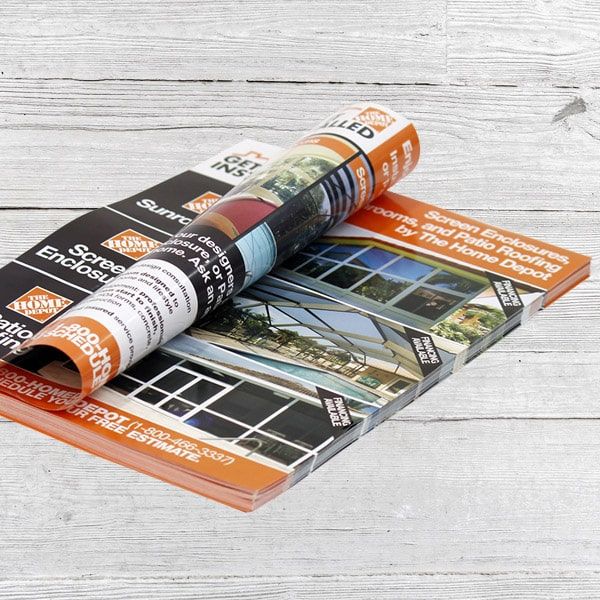
 Some of the 20+ paper stocks we keep in production — from 24lb
linen writing to 80lb satin cover and 11×17 tabloid sheets.
Some of the 20+ paper stocks we keep in production — from 24lb
linen writing to 80lb satin cover and 11×17 tabloid sheets.
Uncoated Text Papers
Natural feel, easy to write on, no shine. Best when content matters more
than visual impact.
| Paper | Also Known As | Feel | Best For | Example |
|---|
| 20# Bond | 50# text, copy paper, 75 gsm | Thinnest — standard copy paper | Flyers, forms, handouts, notepads, draft copies |
A restaurant prints 500 daily special flyers for the counter
|
| 24# Bond | 60# offset text, 90 gsm | Slightly thicker, less see-through |
Letters, invoices, sell sheets, instruction manuals, tri-fold
brochures, double-sided printing
|
A property manager prints tenant welcome packets with info on
both sides
|
| 28# Bond | 70# offset text, 105 gsm | Solid, professional weight | Training manuals, proposals, reports, multi-page booklets |
A nonprofit prints a 20-page program for their annual fundraiser
|
| 32# Bond | 80# uncoated text, 120 gsm | Premium — very little show-through | Executive reports, annual reports, important proposals |
A consulting firm prints a bound client deliverable with charts
|
→ Learn more:
All About 20# Bond Paper
·
How Paper Cost Affects Your Project
Coated Text Papers
Smooth surface that makes colors vivid and photos sharp. Not ideal for
writing. Gloss reflects light (like a magazine); silk has the same color
quality without the shine.
| Paper | Finish | Feel | Best For | Example |
|---|
| 80# Gloss Text | Shiny, reflective | Mid-weight, smooth | Brochures, photo flyers, product catalogs, event programs |
A real estate agent prints property flyers with full-color
listing photos
|
| 80# Silk Text | Smooth, semi-matte | Same weight, elegant feel | Upscale brochures, lookbooks, menus, design portfolios |
A boutique prints a seasonal lookbook with fashion photography
|
| 100# Gloss Text | Shiny, reflective | Heavier, substantial | Premium catalogs, magazine-style publications |
A school district prints a glossy parent handbook with campus
photos
|
| 100# Silk Text | Smooth, semi-matte | Heavier, luxurious |
High-end reports, corporate communications, formal programs
|
A law firm prints client-facing materials that need a premium
feel
|
→ Learn more:
Matte vs Glossy Paper
·
Uncoated vs Gloss vs Matte vs UV
· Paper Coatings Explained
Cover Stock / Cardstock for Color Copies
Printing color copies on cardstock is a common request for postcards,
menus, business cards, and presentation covers. Cover stocks run heavier
and stiffer than text papers — we stock options from 80 lb to 130 lb
cover.
Rigid sheets that don't bend easily — for covers, postcards, dividers,
and display pieces. Note:
"80# cover" is much thicker than "80# text"
because they are measured from different parent sheet sizes.
| Paper | Finish | Feel | Best For | Example |
|---|
| 80# Cover Gloss | Shiny | Light card stock | Book covers, dividers, postcards, table tents |
A café prints table tent inserts for weekend brunch specials
|
| 80# Cover Silk | Smooth semi-matte | Same weight, refined | Elegant covers, presentation handouts, folder inserts |
A wedding planner prints weekend itinerary cards for guests
|
| 100# Cover Gloss | Shiny | Heavier card stock — rigid | Postcards for mailing, booklet covers, signage inserts |
A gym prints promo postcards to mail to nearby neighborhoods
|
| 100# Cover Silk | Smooth semi-matte | Heavy, elegant | Premium covers, certificate backing, formal programs | A university prints graduation ceremony program covers |
| 14pt Board Semi-Gloss | Semi-gloss | Very thick — business card weight |
Heavy-duty covers, point-of-purchase displays, counter cards
| A retailer prints shelf talkers and counter display cards |
| 16pt Board Semi-Gloss | Semi-gloss | Extra thick — premium, rigid | Rigid signage, premium covers, promotional materials |
A brewery prints tap handle display cards for their tasting room
|
→ Learn more:
Card Stock Paper Weight Guide
·
80 lb vs 100 lb Paper
Linen & Specialty Papers
Textured paper with a subtle woven feel. Communicates quality and
formality without heavy design work — ideal for weddings, legal
documents, executive stationery, and formal events.
| Paper | Color Tone | Weight | Best For | Example |
|---|
| 24# Linen Text — Solar White | Bright white | Text (bendable) | Letterhead, formal correspondence, résumés |
A law office prints official letterhead for client
communications
|
| 24# Linen Text — Natural White | Warm, off-white | Text (bendable) | Personal stationery, memorial programs, elegant notices |
A family prints memorial service programs with a warm feel
|
| 100# Linen Cover — Solar White | Bright white | Cover (rigid) | Formal invitations, certificate paper, premium covers | A church prints baptism or confirmation certificates |
| 100# Linen Cover — Natural White | Warm, off-white | Cover (rigid) | Wedding invitations, gala invitations, award certificates | A nonprofit prints annual awards gala invitations |
Colored Papers
The paper itself provides the background color — more economical than
printing a solid color background with ink. Great for color-coding
systems and high-visibility materials. Keep in mind: the paper color
will affect how your printed colors appear.
| Type | Available Colors | Weights | Best For | Example |
|---|
| Pastel | Blue, Orchid, Green, Goldenrod, Pink | 20# and 24# |
Color-coded forms, routing slips, department-specific docs,
attention-getting handouts
|
A school prints hall passes on goldenrod so they're easy to spot
|
| Bright |
Solar Yellow, Re-Entry Red, Pulsar Pink, Galaxy Gold, Terra
Green
| 24# |
Safety notices, sale tags, clearance signs, high-visibility
flyers
|
A retail store prints CLEARANCE shelf tags on Solar Yellow
|
→ Learn more:
How Paper Costs Affect Your Printing Project
Need Waterproof or Tear-Resistant Paper?
Synthetic plastic paper is available through our other products:
Plastic Restaurant Menus
for waterproof menus and outdoor reference sheets, or
Spiral Bound Booklets on Synthetic Paper
for field guides and construction manuals. Learn more in our
Synthetic Plastic Paper guide.
 Color copy paper and printing comparison showing uncoated, coated
gloss and 14pt board with UV coating
Color copy paper and printing comparison showing uncoated, coated
gloss and 14pt board with UV coating
Finishing Options Available
After your color copies are printed, we can apply any combination of
these finishing options. These are configured directly in the calculator
— select what you need and your price adjusts instantly:
- Folding — half fold, tri-fold, z-fold, gate fold,
accordion fold
- Drilling — 2-hole or 3-hole punch for binder
insertion
- Collating — pages assembled in order, ready to
distribute
- Stapling — corner staple or side staple
- Scoring — crease line for clean folding on heavy
stock
- Lamination — gloss or matte protective coating
- Sequential numbering — unique numbers on each
copy (raffle tickets, forms, invoices)
- Variable data printing — personalize each copy
with different names, codes, or text
- Perforating — tear-off sections for tickets,
coupons, or reply cards
Not sure which finishing option you need? Call us at 1-877-421-0668 and
we'll walk you through it.
Who Uses This Product
This color copy product serves professionals who need precise control
over their print specifications. Whether you need colored copies of
marketing materials, print color documents for a presentation, or
produce 8.5 x 11 color printing for an event, here are common use cases:
- Training departments — Custom manuals with numbered
pages, laminated covers, and tabbed dividers on cover stock. Variable
data lets you print each trainee's name on their copy.
- Real estate offices — Property listing flyers on 80#
gloss cover with full-bleed photos. Printed in batches of 100-500 per
listing, updated as needed.
- Restaurants and bars — Seasonal menu inserts on
coated gloss text, table tents on cover stock. Rush production
available when menus change mid-week.
- Nonprofits and churches — Event programs on linen
paper for formal occasions. Fundraiser materials printed at volume for
the lowest cost per piece.
- Schools and universities — Student handbooks, course
packets, and orientation materials. Color-coded on pastel paper by
department or grade level.
- Small businesses — Sell sheets, price lists, and
product catalogs on silk text for a professional look without the
glare of gloss.
Frequently Asked Questions
This product offers over 20 paper stocks organized into four
categories:
- Uncoated text-weight papers (20#, 24#, 28#,
32# bond) — natural feel, easy to write on. Great for forms,
handouts, manuals, and anything that gets handled
frequently.
- Coated text-weight papers (80# and 100# in
gloss or silk) — smooth surface that makes colors vivid and
photos crisp. Best for brochures, catalogs, and image-heavy
materials.
- Cover stock (80# cover, 100# cover, 14pt
board, 16pt board) — rigid card stock for postcards, book
covers, dividers, and display materials.
- Linen papers (24# text and 100# cover, in
solar white or natural white) — textured paper with a woven
feel, ideal for formal invitations, letterhead, and
certificates.
- Colored papers — pastel shades (20# and
24#) and bright/neon colors (24#). Economical way to add a
bold background without using ink.
Not sure which paper is right for your project? See the paper
comparison tables above, or explore these guides:
Need waterproof or tear-resistant copies? Synthetic plastic
paper is available through our
Plastic Restaurant Menus
and
Spiral Bound Booklets on Synthetic Paper
products.
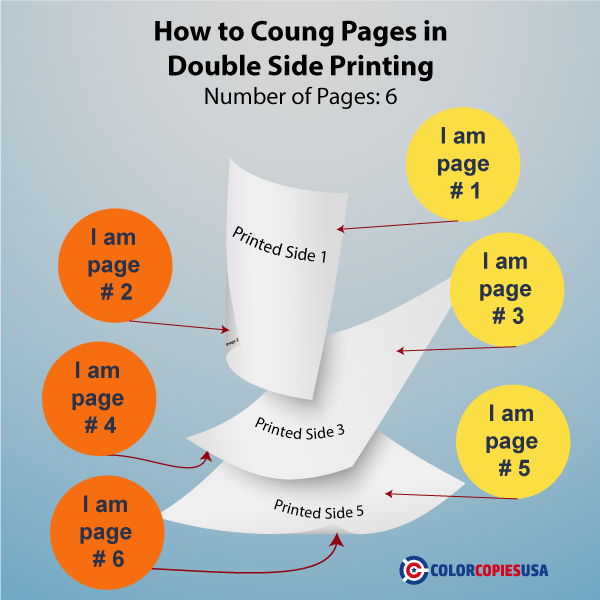
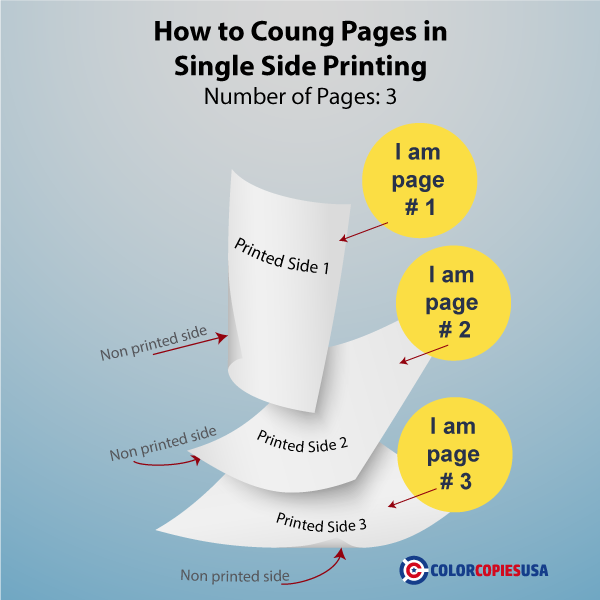
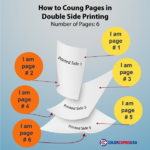
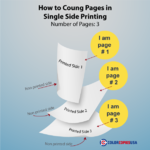
In printing, a "page" means one side of a sheet of paper. If
you print on both sides of a sheet, that's 2 pages on 1 sheet.
- Single-sided (1-sided): Each sheet has
printing on the front only. 10 pages = 10 sheets.
- Double-sided (2-sided): Each sheet has
printing on both front and back. 10 pages = 5 sheets.
Our calculator includes a built-in verification tool: as you
configure your order, it shows you exactly how many sheets of
paper will be used and how many printed sides your job
contains. Use this to confirm your order matches what you
expect before checkout. If the numbers don't look right,
adjust your page count or sides setting.
Our equipment — including the Revoria Press EC1100 by Fujifilm —
produces vivid, professional-quality color, especially on coated
papers where the coating prevents ink absorption.
Three factors affect how colors look on the final print:
- Paper type: Coated gloss and silk produce the
most vibrant colors. Uncoated papers absorb more ink and appear
softer. Colored paper shifts all printed colors (blue ink on
goldenrod leans green).
- Screen vs. print: Monitors use RGB light;
printers use CMYK toner. Some colors — bright neons, certain
blues — can't be exactly reproduced in print. A universal
printing limitation, not specific to our equipment.
- File prep: For the most accurate color, submit
CMYK files at 300 DPI. RGB files convert automatically, but
conversion can shift some colors.
Best results: coated paper + high-resolution PDF
in CMYK.
No — and this is true for all commercial printing, not just
ours. Here's why:
Computer monitors, phone screens, and home/office printers all
display color differently. Monitors use backlit RGB light,
while commercial printers use CMYK toner or ink applied to
paper. These are fundamentally different color systems, so an
exact match between screen and print is not physically
possible.
What we do guarantee is
consistency within your order — all copies in
your run will look the same. We keep our equipment
professionally calibrated and maintained to produce stable,
reliable output.
However, we want to be upfront:
we do not provide color-matching guarantees.
Colors may vary slightly between different print runs, and
between digital and offset production methods. If your project
requires precise color matching (such as matching a specific
Pantone color or a previous print run), please contact us
before ordering so we can discuss options.
Everything happens through the calculator on this page:
- Configure your order — select paper stock,
quantity, single or double-sided, and any finishing options.
Your price updates instantly as you change options.
- See your delivery estimate — enter your ZIP
code and the calculator shows your estimated production
time, shipping time, and in-hand date.
- Upload your files — attach your print-ready
PDF or design file. You can also use our free online
designer to create your artwork from scratch or from a
template.
- Check out and pay — no account is required
to get pricing, but creating a free account gives you access
to order history, saved designs, and reorder tools.
Our pricing rewards volume — the more copies you order, the
lower your per-copy cost. The calculator makes this
transparent so you can find the right balance of quantity and
budget for your project.
We cannot guarantee an exact color match between separate
print runs. Here's why:
-
Different production dates may mean different equipment
calibration states, humidity levels, or toner batches.
-
Your reorder may be printed on a digital press while the
original was offset (or vice versa), depending on the most
efficient method for the quantity ordered.
-
Paper stocks from different manufacturing batches can have
subtle variations in whiteness or coating thickness.
We keep our equipment professionally calibrated, and the
results will be consistent and professional. But if you're
placing two orders that will be displayed side-by-side (for
example, a second batch of brochures to sit next to the first
batch on a rack), we recommend ordering the full quantity in a
single run.
PDF is strongly preferred — it preserves fonts,
layout, images, and colors exactly as designed. Settings for best
results:
- CMYK color mode (not RGB)
- Images at 300 DPI or higher
- All fonts embedded
-
0.125" bleed if your design goes to the edge —
Full Bleed Printing Guide
Other formats by software:
- JPEG, TIFF, PNG: ✓ accepted at 300+ DPI for
print quality.
- Adobe InDesign / Illustrator: ✓ native files
accepted.
- Microsoft Word: ⚠ accepted, but Word doesn't
embed formatting — fonts may shift, spacing may change, elements
may move when opened on our systems. Export to PDF first whenever
possible.
- Microsoft PowerPoint: ⚠ same caveats as Word.
Export to PDF for reliable results.
- Canva: ✓ now produces good print-ready files.
Export as "PDF Print" with crop marks and bleed enabled.
Check that text isn't cut off at edges and images aren't
pixelated.
Yes — we can scan a physical original on our production equipment
(sometimes called "scanning from the glass"). A few things to know:
- Not a walk-in service. Your job is queued in our
production schedule — not finished while you wait.
- Scanning surcharge applies. Amount depends on
size, condition, color correction, and prep needed for a clean
scan.
- Quality depends on the original. A crisp, clean
original scans better than a faded or creased one.
Call 1-877-421-0668 before ordering
— we'll review your original, estimate the scanning cost, and tell
you what to expect.
You reach our actual production team — not a call center — so the
person helping you understands printing and can give specific,
practical advice.
- Phone: 1-877-421-0668 (Eastern time, business
hours)
- Email: contact form on our website
- File review on every order: if we spot an issue
— resolution, bleed, fonts — we'll contact you before printing.
We help with paper selection, file setup, rush orders, finishing
choices, and design troubleshooting. Hablamos español.
Both. You can pick up at our production facility in Oakland
Park, Florida (near Fort Lauderdale) — just call ahead to
confirm your order is ready. We also ship nationwide via
FedEx, UPS, and USPS, with ground delivery typically taking
1–6 business days. Expedited options are available at
checkout. The calculator shows estimated arrival dates based
on your ZIP code, or call 1-877-421-0668 to confirm before
ordering.
Bleed means colors or images extend to the
very edge of the paper with no white border. We print on an
oversized sheet and trim to final size. Your file needs an
extra ⅛" of image beyond the trim line on all sides, plus crop
marks so our equipment knows where
Digital printing produces copies directly from your PDF
— no plates needed. It's faster, has no setup fee, and
is the most economical choice for runs up to about 2,500
copies. This is the technology used when you order through the
calculator on this page.
Offset printing uses custom plates and is more cost-effective
for larger runs (typically 3,000+ copies). The per-unit cost
is lower at high volume, but setup takes longer and requires a
larger minimum to be worthwhile.
Quick rule of thumb: Under 2,500 copies?
Digital (this page). Over 3,000 identical copies? Call us at
1-877-421-0668 and we'll
compare both options for your job.
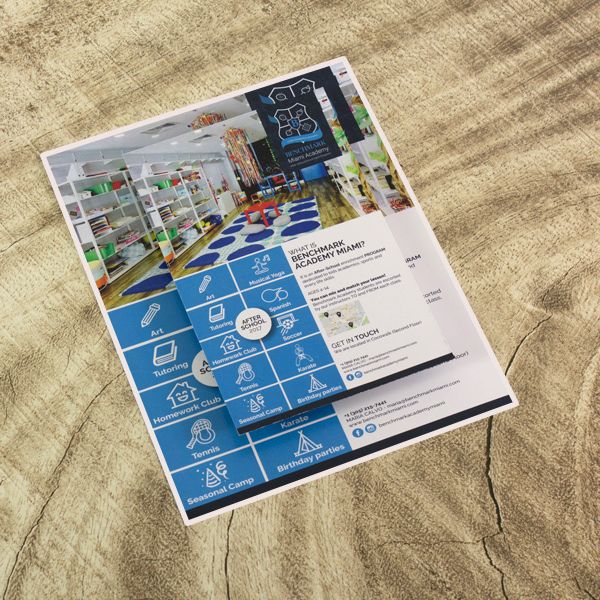
Double-sided color printing — also called duplex or two-sided
— prints on both sides of the sheet.
Why double-sided is usually the smarter choice:
- Half the sheets. A 100-page document prints on 50
sheets double-sided versus 100 sheets single-sided.
- Half the weight. Lighter to carry, lighter to ship
— meaningful for handouts, training manuals, and bulk
mailings where shipping costs scale with weight.
- Lower paper cost. Those extra sheets in
single-sided printing aren't free — the paper itself is a
meaningful part of every print job's price.
- Slightly slower per sheet. Double-sided requires
an extra pass through the press, which adds a small amount to the
per-sheet cost — but the paper savings almost always more
than offset it.
One thing to watch: on very thin papers or with
heavy ink coverage, you can sometimes see ink show-through from the
back side. If your file and stock combination might cause this,
we'll flag it before printing — or call us at
1-877-421-0668 if you're not sure
which paper to choose.

 Proudly Printed in the USA by our 5-Star Team