
Spiral Coil Binding: Durable, Lay-Flat Books | ColorCopiesUSA
Spiral / Coil Binding
The durable, flexible choice for documents that need to lay flat and turn 360° with ease. Perfect for manuals, workbooks, reports, and more!
Page Contents
How Spiral Coil Binding Works
Durable, Flexible, Functional
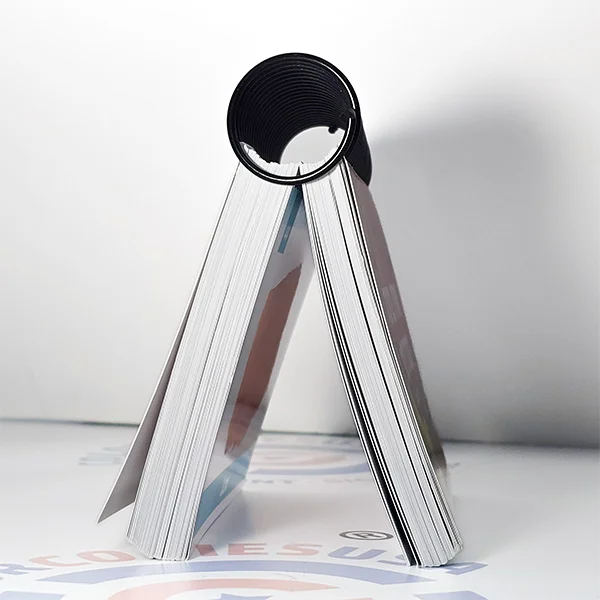
Spiral coil binding involves punching a series of small, closely spaced holes along the binding edge of your collated pages. A continuous, spring-like plastic or metal coil is then spun through these holes.
The ends of the coil are crimped to secure the pages, creating a durable spine that allows pages to turn effortlessly and lay completely flat. This makes it an incredibly practical choice for frequently used documents. Learn more about our many binding options.
Pros: Why Choose Spiral Coil Binding Printed on Paper?
Lays Perfectly Flat & 360° Rotation
Pages open flat and can even fold back on themselves, making it ideal for note-taking, presentations, and easy reading.
Highly Durable & Resilient
Plastic coils resist crushing and bending, returning to their original shape. Pages are securely held and less prone to tearing.
Coil Colors & Size Variety
Choose from a wide array of coil colors to match your branding, and various diameters (up to 50mm offered by some, ColorCopiesUSA up to 30mm as per FAQ later) to accommodate thin or very thick documents.
Accommodates Many Page Counts and Sizes
Effectively binds both thin and thick documents, from a few pages up to several hundred. ColorCopiesUSA can bind up to 18" long on the coil side, perfect for landscape books or custom sizes.
Excellent for Writing & Reference
The lay-flat design is perfect for workbooks, journals, cookbooks, and manuals that need to stay open or be written in.
Versatile Applications
Suitable for reports, proposals, calendars, menus, training materials, and any document requiring frequent, easy handling.
Extra Pros: Coil Bound Books on Synthetic Paper
Weather-Proof & Ultra-Durable
Our synthetic papers (polyester/polypropylene based) are tear-resistant and waterproof. Spills wipe off, making them ideal for harsh environments, field guides, and long-lasting manuals.
Longevity & Integrity
For documents requiring maximum durability and resistance to wear, grease, and tear, coil-bound synthetic paper is the ultimate choice.
Personalized & Printable
Benefit from full-color, personalized printing on these robust synthetic stocks, combined with the practicality of coil binding.
ColorCopiesUSA Specialized Coil Binding
Extended Length Binding
We offer coil binding up to 18 inches long on the binding edge, perfect for landscape architectural plans, large-format presentations, and custom-sized books.
Protective Covers
Enhance durability with optional clear plastic front covers and sturdy black vinyl back covers, protecting your pages while maintaining a professional look.
Landscape & Custom Orientations
Coil binding is exceptionally well-suited for landscape-oriented books, allowing them to lay flat and turn pages easily, a feature harder to achieve with other methods.
Perfect For Projects Like These
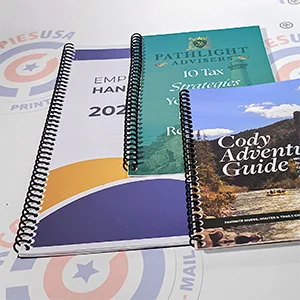
Workbooks & Manuals
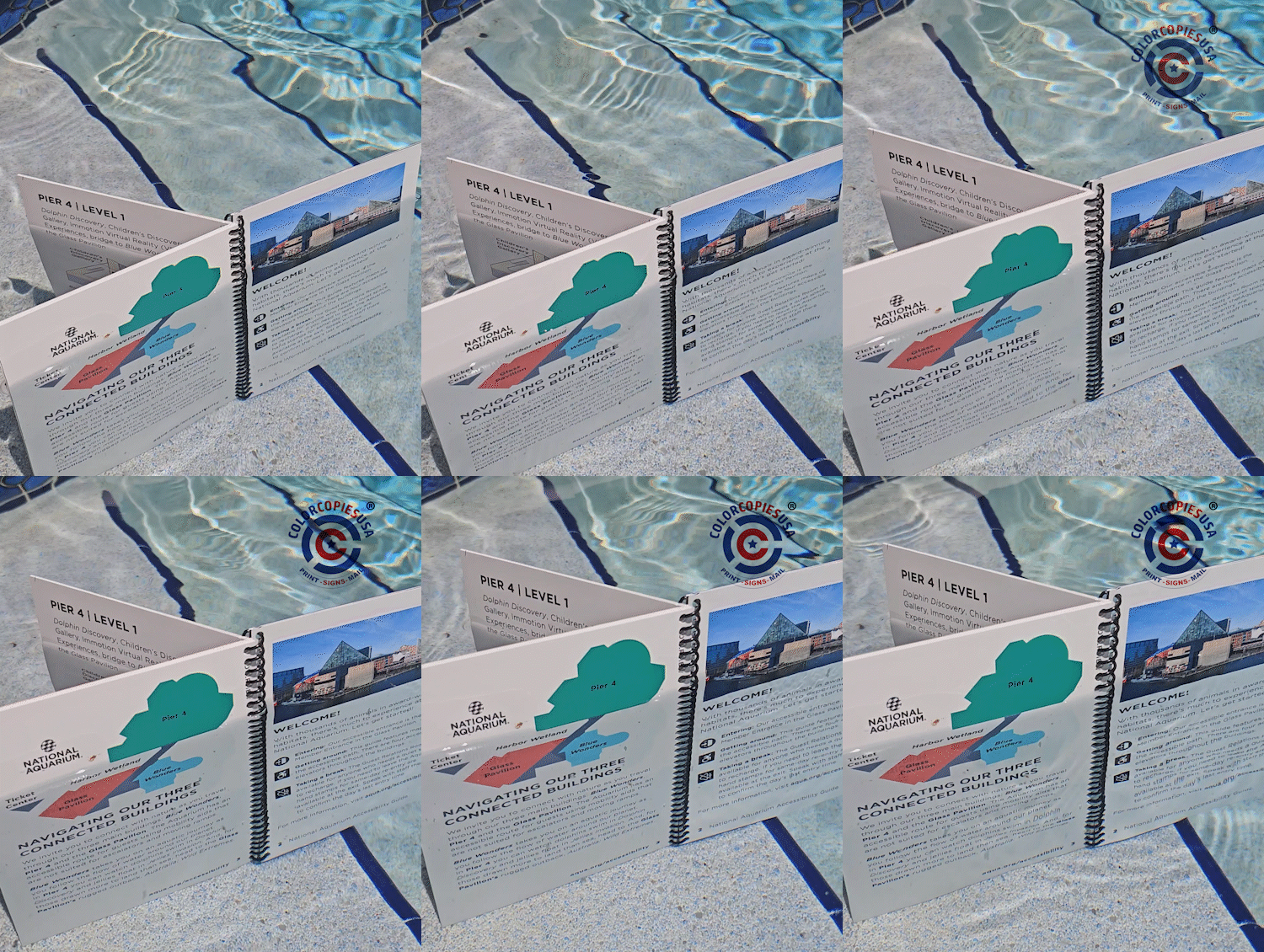
Synthetic Water Safe
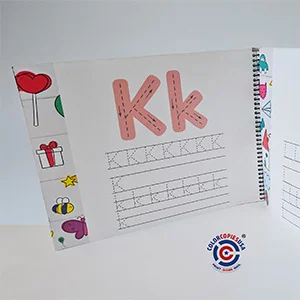
Children's Workbooks

Cookbooks & Events
Coil Specifications & Visuals
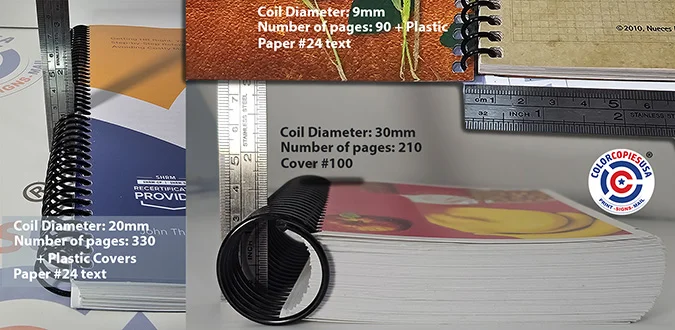
Understanding coil sizes can help visualize your project's thickness. While you don't select the coil diameter (we do that for you based on your page count and paper), this gives you an idea of the possibilities.
Coil Capacity Guide (Approximate)
The number of sheets a coil can hold depends on the paper's thickness. This table provides estimates. Remember, adding cover stock or plastic covers will reduce the number of interior pages that can fit.
| Coil Diameter (mm) | Approx. Size (inches) | Sheets (20# Bond) | Sheets (28# Writing) | Sheets (80# Gloss Text) | Sheets (80# Cover Stock) |
|---|---|---|---|---|---|
| 8 | 1/4" | 28 | 22 | 28 | 14 |
| 10 | 3/8" | 70 | 47 | 67 | 35 |
| 12 | 15/32" | 87 | 70 | 83 | 44 |
| 16 | 5/8" | 127 | 102 | 121 | 64 |
| 20 | 3/4" | 162 | 144 | 171 | 90 |
| 25 | 1" | 210 | 168 | 200 | 105 |
| 30 | 1 3/16" | 255 | 204 | 243 | 128 |
Note: This table is for estimation. We select the optimal coil for your project to ensure easy page turning and a professional finish.
Cons: When Might Spiral Coil Not Be Ideal?
- You need to print text or graphics on the spine (e.g., for shelving).
- Seamless two-page spreads (crossovers) without any interruption are critical for your design.
- A very slim, non-bulky profile is essential, and page count is low (saddle stitch might be better).
- The document requires the most formal or "premium book" appearance (perfect binding or case binding might be preferred).
- Pages need to be easily added or removed after binding (consider a 3-ring binder).
For example, see our:
Binder OptionsIs Spiral Coil the Right Fit?
- Your document MUST lay perfectly flat or fold back 360 degrees.
- It will be frequently used, referenced, or written in (e.g., manual, workbook, journal).
- Durability and resilience of the spine are important.
- You want color options for the binding coil to match branding.
- Printing on the spine is NOT a requirement.
- Minor interruption for crossover designs is acceptable. Read about designing booklets with images that crossover to the next page..
If you checked most of these, spiral coil binding is likely an excellent choice for your project!
Things to Keep in Mind
While ColorCopiesUSA selects the optimal coil diameter for your project based on page count and paper type, understanding capacity can be helpful. Coils are available in various diameters, typically measured in millimeters.
See our Coil Capacity Guide section for more details on approximate sheet counts for different paper types and coil sizes up to 30mm, which is a common maximum we use for calculations.
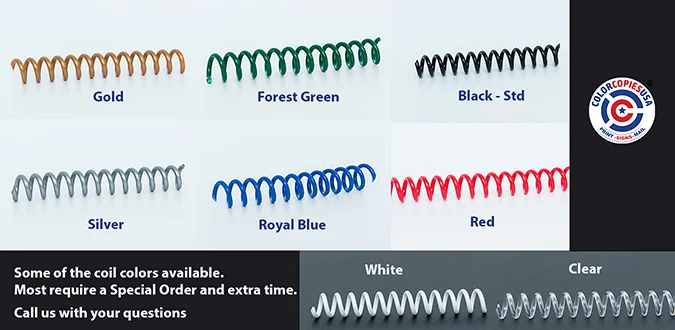
- Coil Colors: Standard colors like black, white, and clear are readily available. A wide array of other colors can be sourced, though this may affect turnaround time and cost. Please inquire for specific color requests.
- Coil Material: We primarily use durable PVC plastic coils for their resilience and flexibility.
Crucial: Binding Edge Safety Margin!
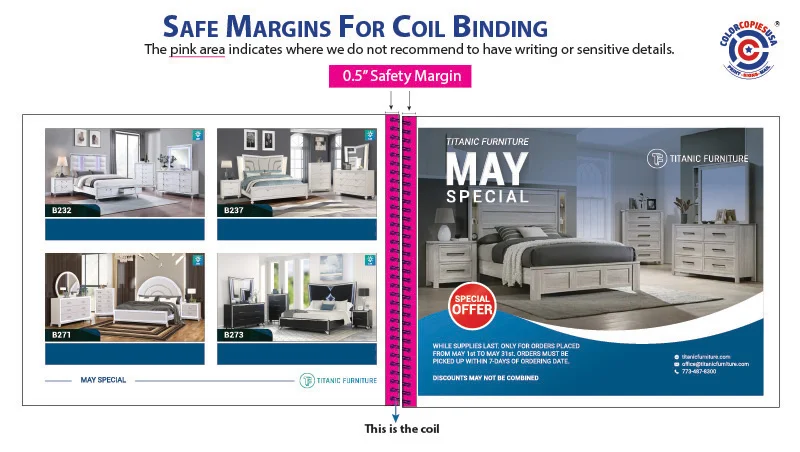
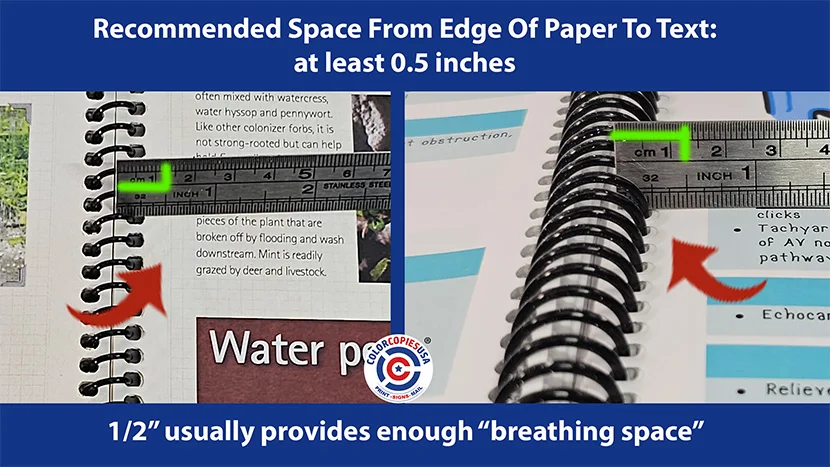
To ensure no important text or design elements are cut off by hole punching or obscured by the coil, a safety margin is essential on the binding edge.
- We recommend a minimum of 0.5 inches (1/2 inch or approx. 13mm) from the raw edge of the paper to where your critical content begins. This applies whether your design bleeds to the edge or not.
- For thicker books requiring larger coils, this margin might need to be slightly larger. If unsure, providing a larger margin is safer.
Other Design Tips:
- Crossovers (Two-Page Spreads): Remember pages do not sit flush. There will be a gap and slight misalignment due to the coil. Avoid placing critical fine details or text directly across the spread at the binding edge.
- File Setup: Submit your document as a single-page PDF in correct reading order with all pages at the final desired size. Include standard 1/8 inch bleeds if artwork extends to any edge.
Spiral coil binding is renowned for its robustness in everyday use:
- Coil Memory: Plastic coils can be bent or compressed and will spring back to their original shape.
- Page Security: Pages are securely held and less likely to tear out.
- Shipping Resilience: Less susceptible to transit damage.
- User-Friendly: Easy to hold, use on a crowded desk, or reference while working.
Tip: For maximum durability, consider using a heavier cover stock, lamination, or our coil-bound synthetic paper options.
Frequently Asked Questions (FAQ)
This "gutter" or "binding margin" provides enough space for the punched holes and the coil itself, ensuring no content is compromised.
It also creates a visually pleasing "air" around the binding, enhancing the reading experience. For very thick books requiring larger diameter coils, a slightly larger margin might be advisable.
In typical indoor environments, the coil's integrity will last for many years.
We've never seen brittlness happen, but extreme and prolonged environmental conditions could be a factor to keep in mind (like constant, direct, intense sun exposure or extreme temperatures not typical for document use).
While here in the US we primarily use the imperial system (inches), spiral coils are manufactured to global standards.
The majority of countries worldwide use the metric system, so coil diameters are standardized in millimeters (mm) for international consistency in manufacturing and supply chains. We prepared a table that is sitting on this same page, listing the most common coil diameters both in inches and milimiters, and referring to their sheet capacity for different paper types.
Written by: Gustavo Baner
Published by: ColorCopiesUSA
Date Published: May 3, 2025
Last Updated: May 20, 2025
About the author: Gustavo Baner is a senior print advisor at ColorCopiesUSA with over 20 years of hands-on experience in commercial printing, file preparation, and helping businesses and creatives produce stunning printed materials. He specializes in matching project needs with the optimal binding solutions.